
78 minutes that lasted a week
At 04:09 UTC on Friday, July 19, 2024, just after midnight in New York and a little after 5 a.m. in London, the security company CrowdStrike pushed a routine update to its Falcon sensor, software that protects millions of Windows computers. The update was not new code. It was a small configuration file, known as Channel File 291, that tells the sensor what suspicious behaviour to look for. Updates like it went out several times a day.
This one crashed every Windows machine that received it and was online to pick it up. Computers showed the “blue screen of death”, restarted, loaded the file again and crashed again. Airlines grounded flights. Hospitals postponed procedures. Banks, broadcasters, emergency call centres and supermarket tills went dark around the world.
CrowdStrike spotted the problem and reverted the file at 05:27 UTC, 78 minutes after it was released. That stopped new machines from being hit. It did nothing for the machines that were already crashing, because they could not stay up long enough to receive the fix. Many had to be repaired by hand, one at a time: boot into safe mode, delete the file, restart. On machines with encrypted drives, someone first had to find the recovery key.
Microsoft later estimated that about 8.5 million Windows devices were affected, less than 1% of all Windows machines. It was enough. Delta Air Lines alone reported about 7,000 cancelled flights over five days and roughly US$380 million in lost revenue, and its chief executive put the total cost at about half a billion dollars. Delta and CrowdStrike have since taken each other to court over who is responsible.
This article is about the lesson that matters for anyone who changes live systems: a change that reaches everyone at once can hurt everyone at once. It ends with a release-readiness checklist you can use on your next go-live.
What actually went wrong
CrowdStrike published a detailed root cause analysis on August 6, 2024. Stripped of the technical terms, it describes three problems lining up.
- A mismatch nobody caught. A detection template introduced in February 2024 was defined with 21 input fields, but the sensor code that used it only ever supplied 20.
- Tests that never touched the problem. For months, every test and every live update used a “match anything” wildcard for the 21st field, so the sensor never actually tried to read it. On July 19, one of two new updates used a real value in that field for the first time. The sensor reached for a 21st value that wasn’t there, read past the end of its data, and crashed the computer.
- A validator that checked the wrong thing. CrowdStrike’s automated Content Validator approved the file, because it checked the update against the template’s definition (21 fields) rather than what the sensor would really supply (20). The report calls this a logic error.
Those three problems explain why the file was broken. A fourth explains why it broke so much: the update went to every online customer at once. CrowdStrike’s own report lists staged deployment as a fix: “Each Template Instance should be deployed in a staged rollout.”
“It’s just configuration” is how outages start
The CrowdStrike file was treated as content, not code. Content updates moved faster and with lighter checks than software releases, because they were seen as lower risk. The file still ran inside the most sensitive part of the operating system, and it still took machines down.
Most organizations have the same blind spot somewhere. Firewall rules, feature flags, pricing tables, routing rules, scheduled jobs and cloud permissions are all “just configuration”. Each can stop a business as completely as a bad code release, and each is often changed with less review, less testing and no rollout plan.
A useful test: if a change can stop a customer from doing business, it is a release, whatever the team calls it, and it needs a release’s discipline.
How a staged rollout works
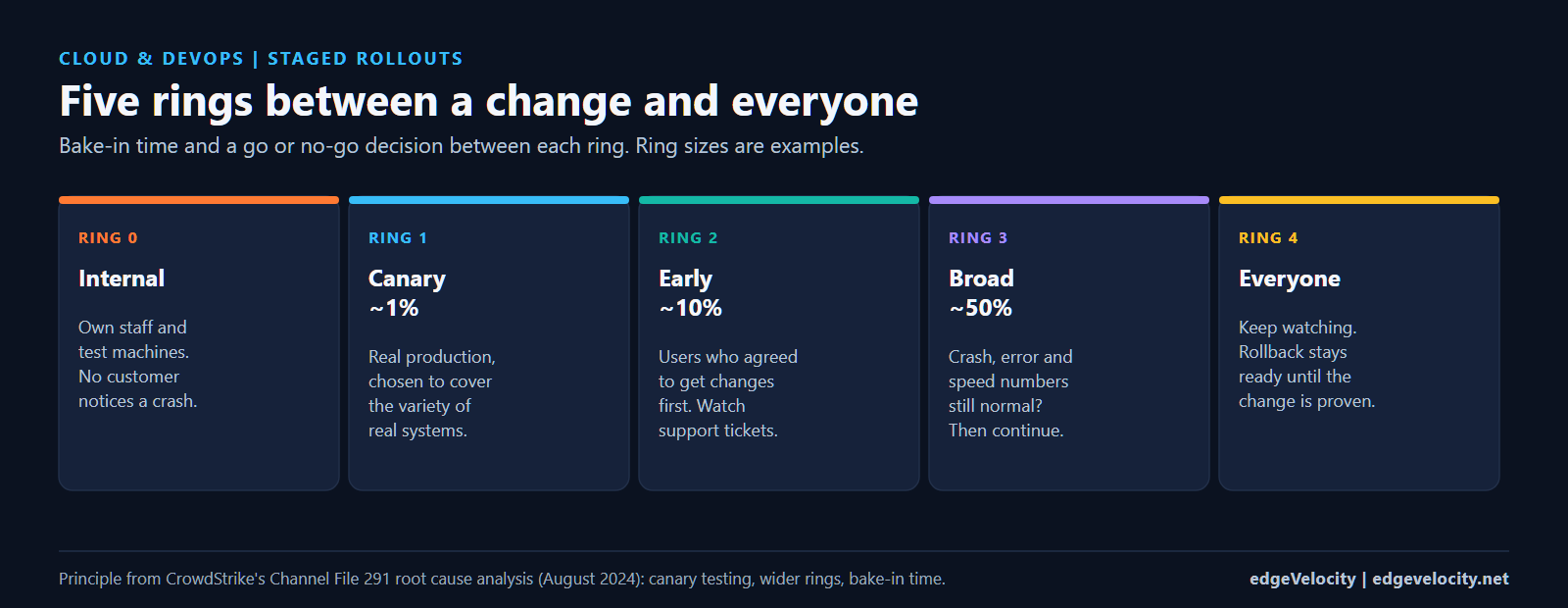
A staged rollout (also called a canary release or ring deployment) sends a change to a small group first, watches what happens, and only then widens it. CrowdStrike’s report describes its new process in exactly these terms: changes that pass canary testing are “successively promoted to wider deployment rings or rolled back if problems are detected”, with “additional bake-in time” at each step while telemetry is gathered.
A typical set of rings looks like this:
- Ring 0, internal. Your own staff’s machines or a production-like test environment. If it breaks here, no customer notices.
- Ring 1, canary. A small slice of real production, often 1%, chosen to represent the variety of real systems.
- Ring 2, early adopters. Around 10%, ideally including users who have agreed to get changes first.
- Ring 3, broad. Half of production.
- Ring 4, everyone.
Between rings there is a pause, the bake-in, and a go or no-go decision based on evidence: crash rates, error rates, performance and support tickets, compared with before the change. If the numbers move the wrong way, the rollout stops and the change is rolled back while it is still small.
Had the July 19 file gone to a 1% canary ring first, the same bug would still have existed. But it would have crashed a fraction of the machines it did, and the alarm would have sounded before the rest received it. That is the whole value of staging: it does not prevent mistakes, it limits how far they travel.
Staging is half the answer. Recovery is the other half.
The revert took 78 minutes. The recovery took days. The difference was the manual work needed on each crashed machine, multiplied by thousands of machines per organization, many of them in airports, stores and hospitals with no technician nearby.
When you plan a release, plan the recovery as seriously as the rollout:
- Can it be undone remotely? If a change can stop a machine from starting, a remote rollback may not reach it. Know that before release, not after.
- Are the keys where you’ll need them? Disk encryption recovery keys, admin passwords and vendor support contacts should be reachable when your normal systems are down.
- Who goes where? For physical sites, decide in advance who can be on site to fix machines by hand, and in what order sites are restored.
- How will you talk to people? If email and chat run on the affected machines, agree a fallback channel now.
Our 60-minute tabletop exercise was written for ransomware, but the same script works for “a vendor update has crashed every laptop”. Run it once with this scenario and you will find most of the gaps above.
Your vendors push changes too
The machines that crashed on July 19 belonged to CrowdStrike’s customers, not to CrowdStrike. Most had no say in when the update arrived. Since the incident, CrowdStrike says customers can choose “where and when” these updates are deployed. Many other vendors offer similar controls, but they are rarely switched on by default.
For every vendor that can push changes into your critical systems, ask three questions:
- Can we stage it? Can updates go to a test group before the rest of the estate, and can we delay updates by a version (often called N-1)?
- Will we know? Do we get release notes before an update lands, and can we subscribe to them?
- What is their rollout? Does the vendor itself use staged rings and bake-in time, and will they put that in writing?
This is the same lesson as our Snowflake third-party risk checklist: the vendor’s controls and your use of the vendor are two different things, and you are responsible for the second.
A release-readiness checklist for project managers
Use this at every go-live gate, for code, configuration and vendor changes alike. A red answer doesn’t always stop the release, but it should be a decision someone makes knowingly, with their name on it.
| Question | Green | Red |
|---|---|---|
| Was it tested the way it will run? | Tested with real values and real data shapes, not only placeholders | Only tested with defaults, wildcards or sample data |
| Who gets it first? | A staged plan: internal, canary, wider rings | Everyone at once |
| What tells us to stop? | Named measures and thresholds, watched during bake-in | “We’ll know if something goes wrong” |
| Who decides go or no-go? | A named person for each ring, with authority to stop | Nobody, or a committee that meets weekly |
| How do we undo it? | A tested rollback that works even if the system can’t start | Rollback untested, or “roll forward with a fix” |
| How long does recovery take at full scale? | Estimated per site and per machine, with people assigned | Never estimated |
| When does it go out? | When the team and support are watching | Late on a Friday, or overnight with no one on call |
| Who needs to know? | Support, service desk and key users told in advance | They find out from the first complaint |
For the bigger picture on release discipline in AI-assisted teams, where more change is flowing than ever, see our guide to what the 2025 DORA research really says.
What to do on Monday
- List the five changes going live in the next month that could stop customers from doing business. Include configuration and vendor updates.
- For each, write down the rollout plan in one line. If the line is “everyone at once”, design at least one smaller ring first.
- Check where your disk-encryption recovery keys are stored, and whether you could reach them if every laptop in the building were down.
- Find out which of your security and infrastructure vendors let you stage or delay their updates, and switch it on for at least a test group.
- Add the checklist above to your go-live gate template.
Frequently asked questions
Was the CrowdStrike outage a cyberattack?
No. CrowdStrike, Microsoft and independent reporting all agree it was a faulty update, not an attack. Criminals did use the confusion for phishing in the days that followed.
Why did a 78-minute problem take days to fix?
Reverting the file stopped new crashes, but machines already crashing couldn’t stay up long enough to receive the fix. Many had to be repaired by hand, one at a time.
Doesn’t staging slow down urgent fixes?
A little. Security updates often need to move fast, so the rings can be shorter. But a short, staged rollout is still far safer than an instant global one, and the July 19 file was not an emergency fix.
We’re not a software company. Does this apply to us?
Yes. Every ERP upgrade, firewall change, pricing update and vendor patch is a release. If it can stop your business, give it a staged rollout and a tested way back.
Sources
- CrowdStrike, External Technical Root Cause Analysis: Channel File 291 (August 6, 2024).
- CrowdStrike, preliminary Post Incident Review (July 2024), for the 04:09 and 05:27 UTC times.
- TechCrunch, Microsoft says 8.5M Windows devices were affected by CrowdStrike outage (July 20, 2024).
- Delta Air Lines, Form 10-Q for the quarter ended September 30, 2024, for cancellations and revenue impact.
- Fox Business, Microsoft, CrowdStrike, Delta: who’s really to blame?, for Delta’s estimate of total cost.