
The nine days nobody noticed
On February 12, 2024, someone logged in to a remote-access portal at Change Healthcare, a company that processes a large share of medical insurance claims in the United States. They used a stolen username and password. According to the prepared testimony of Andrew Witty, chief executive of parent company UnitedHealth Group, before the US Congress, that portal did not have multi-factor authentication.
For nine days, the attackers moved through the network and took data. Then they deployed ransomware. Pharmacies could not process prescriptions through insurance. Clinics could not get paid. UnitedHealth later estimated that the data of about 190 million people had been affected, and by January 2025 it reported the attack’s costs at about US$3.1 billion. Witty told lawmakers the decision to pay a ransom was his. Security researchers put the payment at US$22 million.
Most organizations will never face an attack of that scale. But almost every organization will face the same set of decisions Change Healthcare faced in the first hours, and most will face them for the first time on the worst morning of their year. A tabletop exercise lets you face them first on a quiet Tuesday, with coffee, when getting it wrong costs nothing.
This article gives you a complete 60-minute script you can run with your leadership or project team, no security consultant required.
Why one hour of rehearsal is worth more than another tool
Ransomware recovery is mostly a set of decisions made under pressure: who is in charge, whether to shut systems down, whether the backups can be trusted, what to tell customers, whether to pay. The technology matters, but the speed and quality of those decisions decide the cost.
The numbers show how much rides on one of them in particular. In a Sophos survey of 2,974 organizations hit by ransomware, attackers tried to compromise the victim’s backups in 94% of attacks, and succeeded in 57% of those attempts. Organizations whose backups were compromised had a median recovery cost of US$3 million, against US$375,000 for those whose backups survived. They were also almost twice as likely to pay the ransom: 67% against 36%.
A tabletop exercise is a discussion, not a simulation: no systems are touched. A facilitator reads out a developing scenario in stages, called “injects”, and the team talks through what it would do. The value comes from the gaps it exposes. “Who has the insurer’s phone number?” is a much better question to discover on a Tuesday than during an attack.
The US Cybersecurity and Infrastructure Security Agency (CISA) publishes free, detailed exercise packages for organizations that want to go further. The script below is a compact version designed for one hour.
Before the exercise: 20 minutes of preparation
- Invite 5 to 8 people: the most senior decision maker available, IT or the IT provider, finance, communications or customer service, legal or whoever handles contracts, and the operations lead for your most important process.
- Pick a facilitator who will not be playing a role. Their job is to read the injects, keep time and ask questions, not to solve problems.
- Pick a scribe to write down every gap, question and “we don’t know” as it comes up. That list is the real output.
- Choose your crown-jewel system: the one whose loss would hurt most (billing, orders, the client file system). The scenario centres on it.
- Set one rule: no blame. You are testing the plan, not the people.
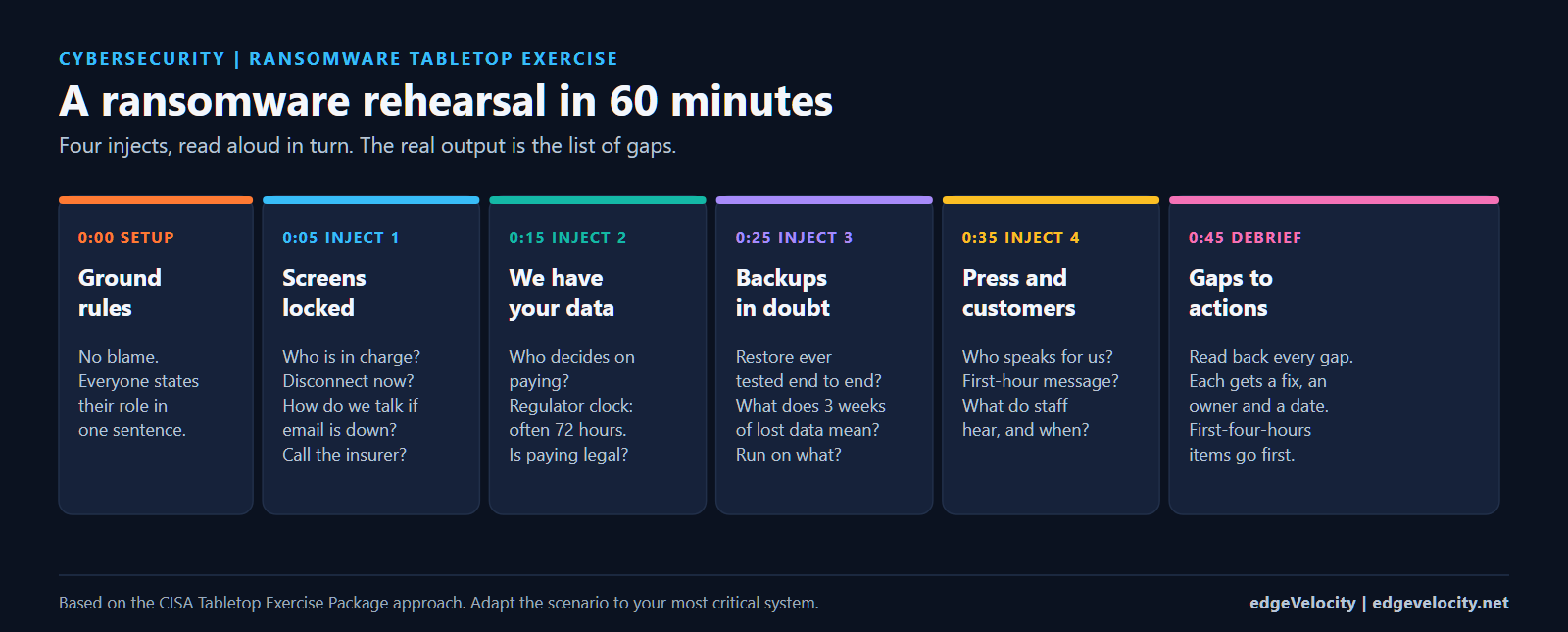
The 60-minute script
0:00 to 0:05. Setup
The facilitator explains the rules: this is a discussion, there are no wrong answers, decisions are made with the information given, and the scribe records gaps. Everyone states their role in one sentence.
0:05 to 0:15. Inject 1: “The screens are locked”
Read aloud: “It is 7:10 AM on a Monday. Staff arriving at the office report that their screens show a message saying files have been encrypted. The [crown-jewel system] is not responding. Two people have already posted about it in the company chat.”
Discussion questions:
- Who is in charge right now, and how does everyone else know that?
- Do we disconnect systems from the network? Who has the authority to decide, and who has the skills to do it?
- How do we communicate if email and chat may be compromised? Do we have phone numbers that don’t live on the company system?
- Who calls our cyber insurer, and do they require us to use their incident response firm?
0:15 to 0:25. Inject 2: “We have your data”
Read aloud: “A ransom note demands payment in cryptocurrency within 72 hours. It says the attackers have copied customer and employee data and will publish it if you don’t pay. It includes a sample: a spreadsheet of real customer names and addresses.”
- Who decides whether to pay, and on what basis? Is it the CEO, the board, the insurer?
- Do we have a legal obligation to notify a regulator, and how quickly? (Many regimes allow 72 hours or less from becoming aware of a personal data breach.)
- Who engages outside legal counsel, and do we already have one we would call?
- Is paying even legal? Payments to sanctioned groups can be prohibited in some jurisdictions.
0:25 to 0:35. Inject 3: “Can we trust the backups?”
Read aloud: “IT reports that the backup server was also reached. The most recent backups may be encrypted. Older backups, from three weeks ago, are on a separate system and appear untouched, but nobody has tested restoring from them in over a year.”
- How long would a full restore from the three-week-old backups take? Has anyone ever done one end to end?
- What would three weeks of lost data mean for each team? Can it be re-entered, rebuilt or recovered from partners?
- What do we run the business on in the meantime: paper, spreadsheets, a backup site?
- If restore takes ten days, does that change the decision about paying?
0:35 to 0:45. Inject 4: “A journalist is on the phone”
Read aloud: “A local news reporter calls reception asking for comment on reports of a cyberattack. Several large customers have emailed asking whether their data is safe. A customer has posted on social media that your systems are down.”
- Who is allowed to speak for the company, and what do we say in the first hour?
- What do we tell customers, and when? Who drafts it, and who approves it?
- What do we tell staff, so they don’t speculate publicly?
- Do any contracts require us to notify customers within a set time?
0:45 to 1:00. Debrief
Stop the scenario. The scribe reads back the list of gaps. For each one, agree on three things: what the fix is, who owns it, and when it will be done. Prioritize anything that would have cost time in the first four hours: authority, contact details, insurer requirements and backup restore times usually top the list.
What a first exercise usually reveals
The following are common findings from exercises in mid-sized organizations, offered as typical patterns rather than a specific case.
- Nobody is sure who is in charge until the senior person in the room says so. Write it down: a named incident lead and a deputy.
- The emergency contact list lives on the system that just went down. Print it. Put it in people’s phones.
- The insurer has requirements nobody has read, such as using an approved response firm or notifying within a set window. Read the policy before you need it.
- Backups run, but restores have never been tested. The difference between “we have backups” and “we can restore in two days” is the single most expensive unknown in ransomware recovery.
- Nobody owns the customer message. Draft a holding statement now, so the first hour isn’t spent arguing over wording.
Turning the exercise into a project
The debrief list is a backlog. Treat it like one. Each gap becomes an action with an owner, a due date and a status, tracked in a RAID log alongside other risks, and reviewed until it closes. Run the exercise again in six months with a different scenario (a vendor breach, an insider, a cloud outage) and compare how many gaps remain.
If the exercise shows that attackers could get in with just a password, as they did at Change Healthcare, our guide to what actually stops breaches covers the ten controls to put in place first, and the third-party access checklist covers the supplier side.
Frequently asked questions
How often should we run a tabletop exercise?
At least once a year, and after any major change: a new core system, a merger, a new IT provider. Twice a year is better for organizations that hold sensitive customer data.
Do we need a security expert to run one?
Not for a first exercise. A well-prepared facilitator with this script will find the biggest gaps. Bring in specialists later to test technical recovery in more depth.
Should IT run the exercise?
IT should take part, but the exercise is mostly about business decisions. A neutral facilitator from outside IT often gets more honest answers.
What if the exercise shows we’re badly prepared?
That is the point, and it is good news: you found out on a quiet day. Prioritize the gaps that would cost time in the first four hours, and fix those first.
Sources
- UnitedHealth Group CEO Andrew Witty, prepared testimony to the US Congress (May 2024), as reported by SC Media and The Register.
- Fierce Healthcare, UnitedHealth estimates 190M people impacted (January 2025).
- Sophos, The impact of compromised backups on ransomware outcomes (2024 survey of 2,974 organizations).
- CISA, Tabletop Exercise Packages.