
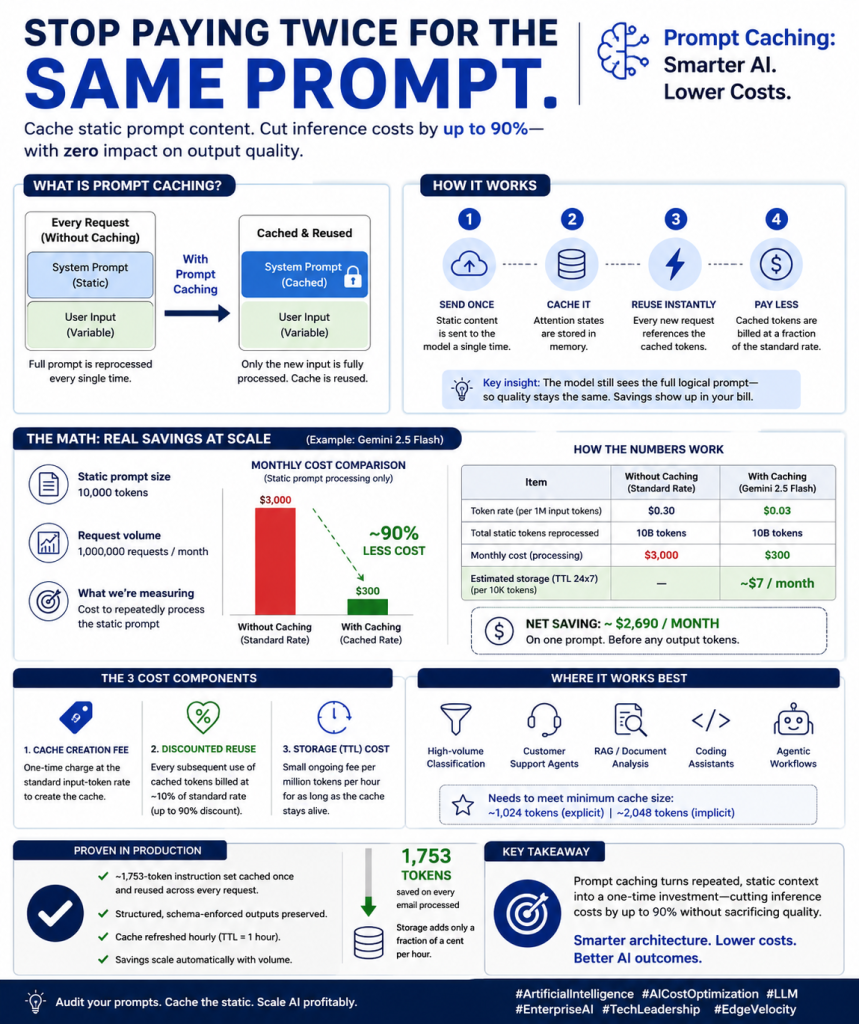
As enterprise AI workloads scale, there is an often-overlooked cost: repeatedly processing the same context.
Think about what an AI agent typically carries on every single call: system instructions, tool definitions, output schemas, few-shot examples, sometimes an entire reference document or policy. If a large share of that content stays unchanged from one request to the next, prompt caching — also called context caching — is worth a serious look. It is not a universal fix, and it does not benefit every workload equally. It is a cost-optimization lever that works well under specific, identifiable conditions.
What caching actually changes
The static portion of a prompt is processed once, its internal state is stored, and subsequent calls reference that stored state instead of recomputing it from scratch. The model still logically receives the same context — caching changes how repeated input is processed and billed, not the business logic of the prompt or the quality of the output.
The mechanism breaks down into four steps: the static content goes to the model once, its attention-state is stored in memory, every new request references that cached state instead of reprocessing the same tokens, and the cached portion is billed at a discount on every call after the first — the size of that discount depends on the provider and model.
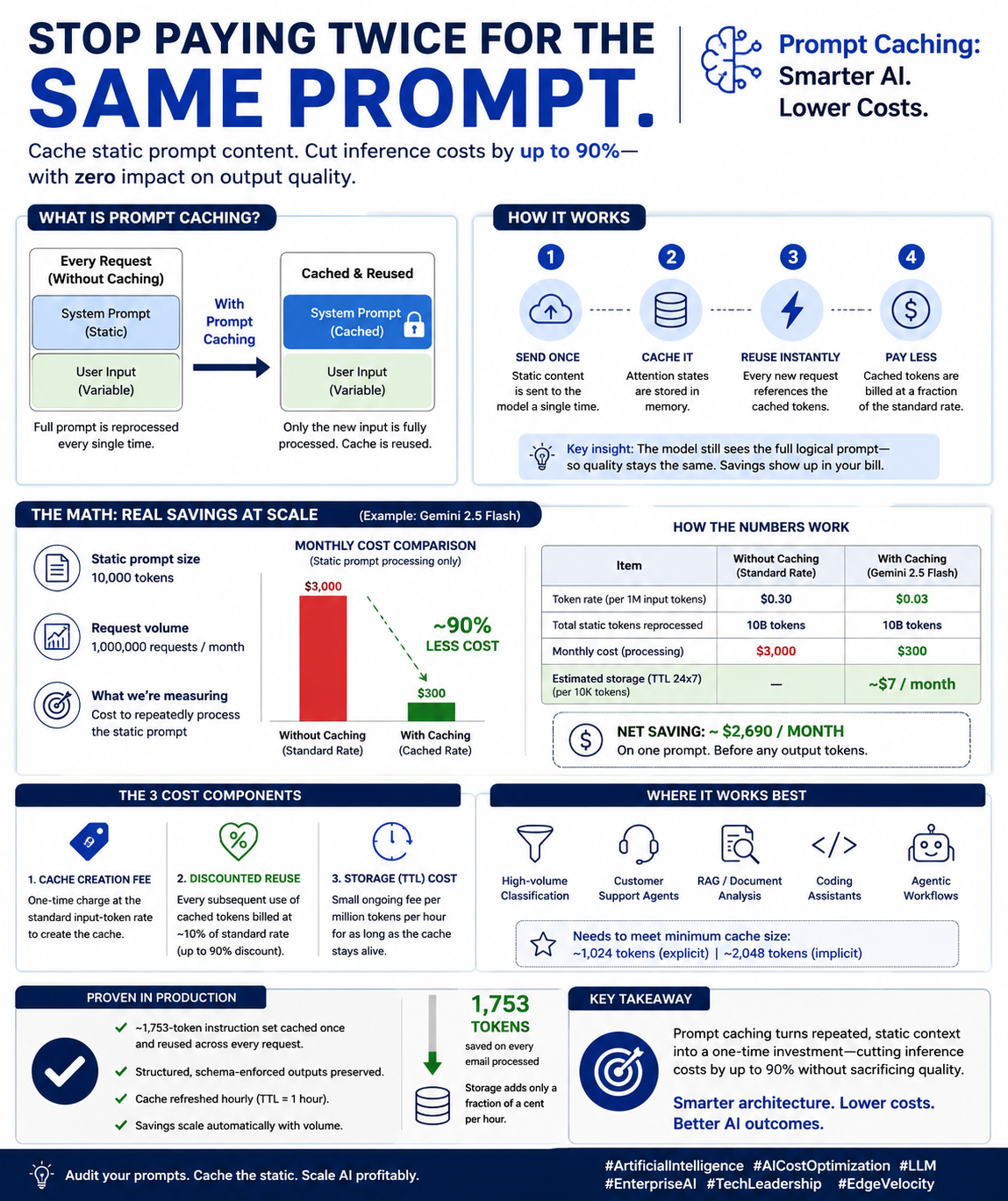
A worked example — not a guarantee
Google’s own documentation frames context caching the same way: it is most useful when substantial context is repeatedly referenced, not as a blanket win for every prompt. The example above is scaled from one model tier’s documented cached-token pricing to show the order of magnitude at stake, not a claim about what any given workload will actually save.
A workload with a low cache-hit rate, a mostly-variable prompt, or a short reuse window will see meaningfully less benefit than the headline number suggests. This has been validated in a live production pipeline: a roughly 1,753-token instruction set for an automated classification workload was cached once and reused across incoming requests, refreshed hourly. The savings scaled with volume — but they scaled because the cache-hit rate was high and the static block genuinely dominated the prompt, not because caching is automatically a win regardless of workload shape.
Where it tends to work well
- High-volume classification
- Customer-service agents
- RAG and document analysis pipelines
- Coding assistants
- Agentic workflows built on large, stable instructions
One-off, highly variable chat prompts are the clearest case where caching adds cache-creation overhead without enough reuse to offset it.
The questions to ask before implementing it
Before treating caching as a given, four questions are worth answering for your specific workload:
- How much of the prompt is actually static?
- How frequently is that static context reused?
- How long does the cache need to remain valid, and what does that TTL cost in storage?
- What cache-hit rate will the workload realistically achieve in production, not in a demo?
An architecture and FinOps consideration, not a model feature
The real opportunity here is not “turn on caching.” It is architecting AI workloads so that expensive, repeated context is identified and handled deliberately — which static content is worth caching, for how long, and how that reuse is monitored once it is live. That framing makes prompt caching less of a single model feature to flip on and more of an ongoing AI architecture and FinOps consideration, sitting alongside model selection, context-window management, and retry strategy as a lever teams should be actively managing, not a one-time setting.
The takeaway
Where does your own AI pipeline carry the most repeated context — and how confident are you in the actual cache-hit rate it would achieve in production?